
Get Organized at Work: Reduce Overwhelm and Focus on What Matters
Apr 01, 2026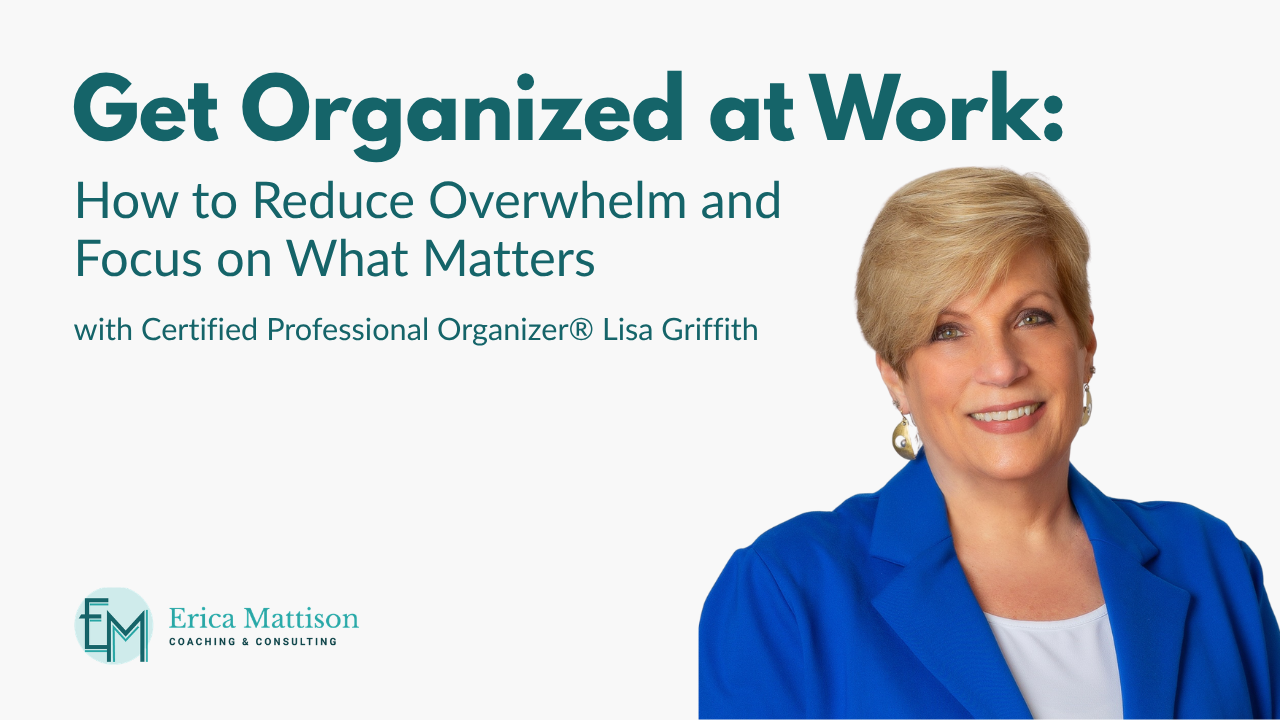
Feeling overwhelmed at work is something many professionals experience, even when they are trying to stay organized. You might have a long to-do list, a full calendar, and a sense that you are constantly catching up.
You may have tried different tools or systems, hoping something will help you feel more in control. And yet, the overwhelm persists.
What often gets overlooked is that organization is not just about tools or tidying up. It is about how you make decisions, how you prioritize, and how you align your time with what actually matters.
In this episode of the Conversations with Erica podcast, I hosted productivity coach and Certified Professional Organizer® Lisa Griffith for a conversation about what it really means to get organized at work and why so many approaches fall short.
Why Getting Organized at Work Is Not About Tools
One of the most important shifts in this conversation is moving away from the idea that organization means having everything perfectly in place.
Many people assume that if they just had the right planner, app, or system, everything would fall into place. In reality, the challenge is rarely the tool.
The challenge is follow-through.
Organization becomes meaningful when it supports your ability to:
-
Make decisions more easily
-
Know what to focus on
-
Complete what matters most
Without that, even the most well-designed system will not hold.
Why You Feel Overwhelmed Even When You Are Organized
Overwhelm often builds when you are trying to hold too much at once.
One of the approaches Lisa Griffith shares in her work is a full “brain dump,” where everything on your mind gets captured in one place. When you see the full scope of what you are carrying, it can shift your perspective.
The issue is not that you are not doing enough. The issue is that there is too much to do.
That awareness allows you to move from trying to do everything toward deciding what actually matters right now.
How Your Calendar Reveals Your True Priorities
As Lisa points out in our conversation, there is often a disconnect between what we say matters and how we are actually using our time.
Many professionals can clearly articulate their priorities, but when you look at how time is actually being used, that gap becomes clear.
Calendars fill with meetings, obligations, and reactive tasks. The work that requires focus, strategy, or creativity gets pushed aside.
Your calendar is not just a scheduling tool. It reflects your decisions, your boundaries, and your priorities.
When your time is not aligned with what matters, it becomes difficult to feel focused or effective.
The Hidden Types of Clutter That Impact Your Work
When people think about getting organized, they often think about clearing a desk or organizing a workspace.
In reality, clutter shows up in multiple ways:
-
Physical clutter such as paper or workspace disorganization
-
Digital clutter such as inboxes, files, and apps
-
Time clutter such as overbooked calendars and scattered to-do lists
These forms of clutter are connected.
You might organize one area and still feel overwhelmed if the others are not addressed.
Why Decision-Making Is the Real Productivity Skill
Clutter often builds because decisions are delayed.
A piece of paper sits on your desk because you are not sure what to do with it. An email stays in your inbox because you have not decided how to respond. A task remains on your list because its priority is unclear.
Over time, these moments add up.
Creating simple criteria for decision-making can reduce friction and help you move forward with more clarity and confidence.
Why There Is No Perfect Productivity Tool
It is easy to believe that the right app or system will solve everything.
But tools do not create change on their own.
What matters more is whether the system:
-
Fits how you naturally think and work
-
Is simple enough to maintain
-
Supports consistent use over time
A simple system that you use consistently will always be more effective than a complex one that you abandon.
Creating Space to Focus on What Matters Most
At its core, getting organized is not about doing more.
It is about creating space.
Space to focus.
Space to think.
Space to engage with what matters most.
That might involve making different choices about your time, letting go of certain commitments, or building systems that support how you work.
The goal is clarity, not control.
If you are looking for additional tools and reflections, explore the resource hub ➔
Listen to the Full Episode
Listen to the full conversation with Lisa Griffith ➔
About Lisa Griffith
Lisa Griffith is a productivity coach and Certified Professional Organizer® who helps professionals create systems that support focus, clarity, and sustainable productivity.
Learn more about Lisa’s work ➔
When You Are Ready to Take the Next Step
If you are noticing a disconnect between what matters to you and how your time is actually being used, that is often a meaningful place to begin.
In my work as an executive coach, I support professionals in stepping back, clarifying what matters most, and making more intentional decisions about how they move forward.
If you would find it helpful to talk that through, you can schedule a Career Consultation ➔
Continue the Conversation
Explore more articles, podcast episodes, and coaching resources ➔
Listen to more episodes of Conversations with Erica ➔